


During peak seasons such as festivals and promotional events in the apparel customization and cultural printing industries, orders surge in concentration. Most small workshops and medium-sized factories face a dilemma:
Hiring more workers increases costs in wages, accommodation, and management; not hiring workers results in missed delivery deadlines and even greater loss from canceled orders.
The dual station electric heat press creates a one-person dual-machine alternating operation model. Without adding labor input, it amplifies single-person output through structural optimization of the equipment, perfectly solving the problem of insufficient production capacity for bulk orders. It is a core tool for cost control and efficiency improvement in small and medium-sized printing factories.
1. Traditional Single Station Equipment Has Unavoidable Capacity Waste
Traditional single station heat press machines have inherent time loss, which is also the root cause of low factory productivity:
1. Machine idle during pressing waiting time
A single product requires more than ten seconds of pressing time. During pressing, the operator can only wait in place with nothing to do. The machine occupies space but continuously wastes time.
2. Large orders can only be accelerated by adding labor
The only way to increase production speed is to add more single station machines and operators, which increases both space rent and labor cost, significantly reducing profit margins of low-margin orders.
3. Fatigue during rush orders leads to quality decline
One operator repeatedly loads material, presses, and removes products for a long time. High-intensity repetitive work leads to slower speed and inaccurate positioning in later stages, increasing rework rates and reducing overall profit despite increased output.
2. Dual Station Alternating Operation Logic Fully Utilizes Waiting Time
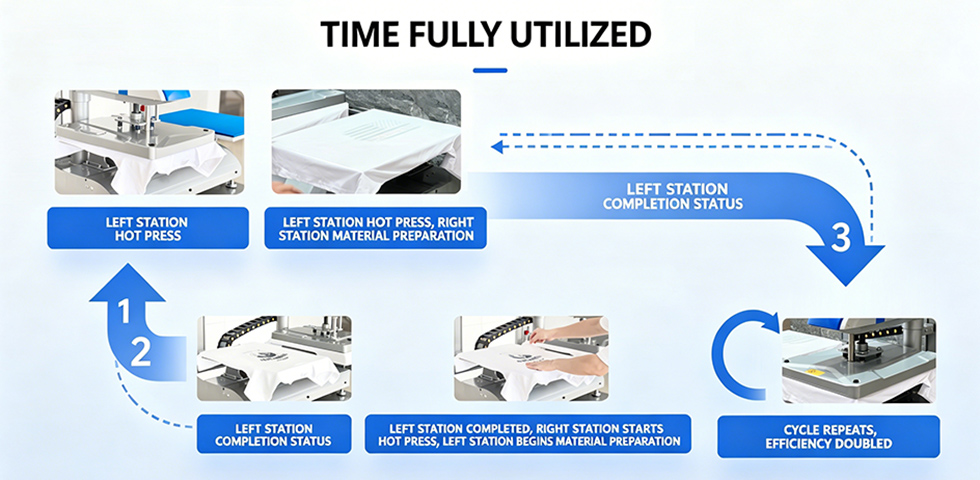
The dual station machine has two independent working tables on the left and right, forming a staggered production line that completely eliminates idle machine time:
When the left station starts pressing and timing, the operator simultaneously places garments and aligns transfer patterns on the right station.
After the left station finishes pressing and automatically lifts, the finished product is removed and the next material is placed, while the right station completes pressing at the same time.
The two stations alternate cyclically, with pressing and material preparation running simultaneously, fully overlapping time and eliminating idle waiting.
The machine is equipped with a unified PID temperature control and balanced pressure system, ensuring that both stations maintain consistent temperature and pressure, avoiding inconsistent product quality caused by dual station design.
3. Tested Output Comparison: Clearly Visible Production Improvement
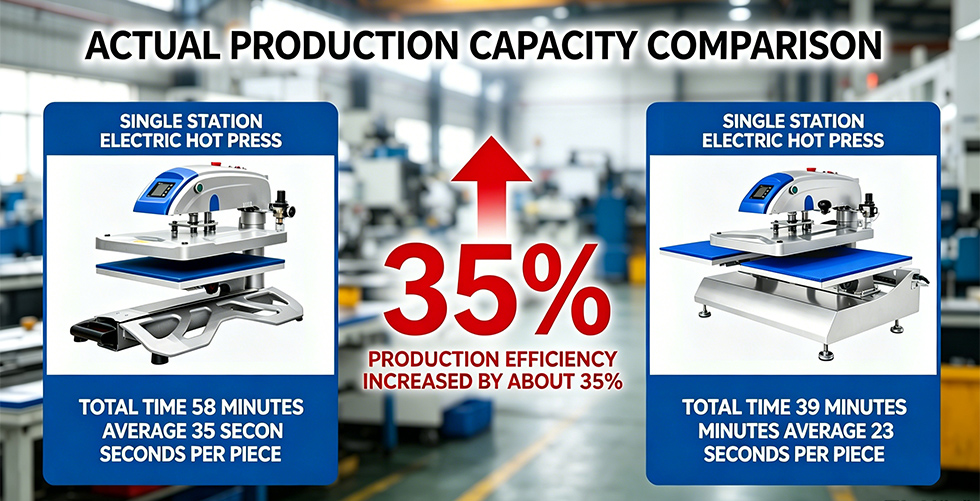
Testing conditions: single operator, cotton T-shirt, PVC heat transfer film, 160°C / 15 seconds process, completing a batch of 100 pieces.
Ordinary single station electric heat press: total time 58 minutes, average 35 seconds per piece
Heat Press Leader dual station heat press: total time 39 minutes, average 23 seconds per piece
Under the same labor conditions, production efficiency increases by approximately 35%. For large-scale demands such as sports team uniforms, corporate workwear, and e-commerce bulk orders, delivery cycles are significantly shortened, and large orders can be handled without additional hiring.
Real feedback from multiple printing factories shows:
After switching to dual station equipment, temporary workers are no longer needed during peak seasons, saving short-term labor costs. Existing employees achieve higher individual output, completing more orders within the same working hours, and overall revenue increases significantly.
4. One-Person Dual Machine Operation Tips: Higher Efficiency with Lower Defect Rate
Before production, lock temperature, pressure, and time parameters on both stations to ensure consistency. Do not adjust parameters separately.
Use positioning clips or heat-resistant adhesive to fix transfer patterns in advance to reduce alignment time.
Take short breaks every 1–2 hours to avoid fatigue-related mistakes such as misalignment or burning.
Clean the heating plate daily at start and end of work to remove residual adhesive and ensure stable heat transfer.
5. Suitable Application Scenarios
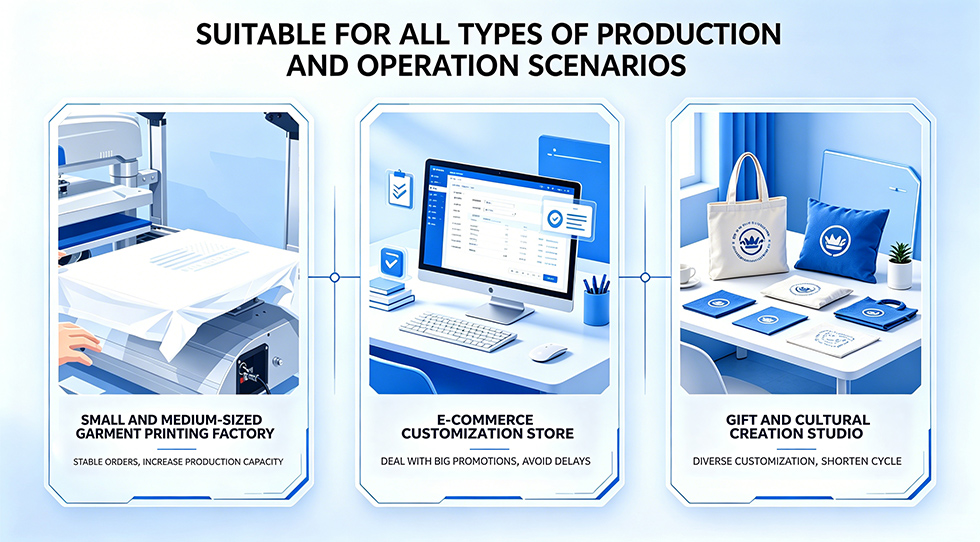
Small and medium-sized garment printing factories: stable bulk orders such as uniforms and school uniforms, improving daily production capacity.
E-commerce custom stores: handling order surges during promotions, enabling fast processing of large numbers of small orders and avoiding late shipment penalties.
Gift and cultural creative studios: producing canvas bags, pillows, mouse pads, and other bulk customized products, shortening customer waiting time.
6. Common Concerns Explained
1. Is dual station operation more difficult for beginners?
The operation logic is exactly the same as single station machines. Only an alternating workflow is added. Users can operate after understanding the cycle process, with no learning barrier.
2. Does processing different materials at the same time affect results?
It is not recommended to use different process parameters on both stations. Frequent temperature and pressure adjustments reduce efficiency. Processing the same batch material is optimal.
3. Is long-term single operator operation safe?
The machine is equipped with an automatic lifting safety system. As long as hands are not placed in the heating area and regular breaks are taken, risks can be avoided.
Conclusion
In today’s printing industry, labor and space costs are increasing year by year. The traditional model of expanding production by simply adding workers and machines is no longer profitable.
The dual station heat press, through its unique alternating operation structure, maximizes single-person working time. Without increasing labor cost, it improves production capacity by 35%, balancing both output speed and product quality.
For factories and studios that handle bulk orders and frequently face peak season surges, a dual station heat press is the most cost-effective solution for expanding capacity and protecting order profit margins.
Post time: Jun-06-2026
 86-15060880319
  sales@xheatpress.com